
When a regulatory submission runs into delays, the first suspect is usually the science. In practice, much of the friction comes from the documents themselves: summaries that don’t make the case, numbers that differ between sections, and statements a reviewer can’t trace back to data. Each of these can lead to questions from FDA, EMA or MHRA reviewers, and every question costs time. The encouraging part is that these problems are largely preventable. Here are ten that commonly cause delays, with a practical fix for each.
1. Starting the writing too late
When document planning begins only after data lock, writing becomes a race against the submission date. Quality is the first casualty, and review rounds get squeezed. Instead, build a document plan early, with owners, templates, dependencies and review dates. Draft shells and non-data sections before the data are final.
2. Inconsistent data across documents
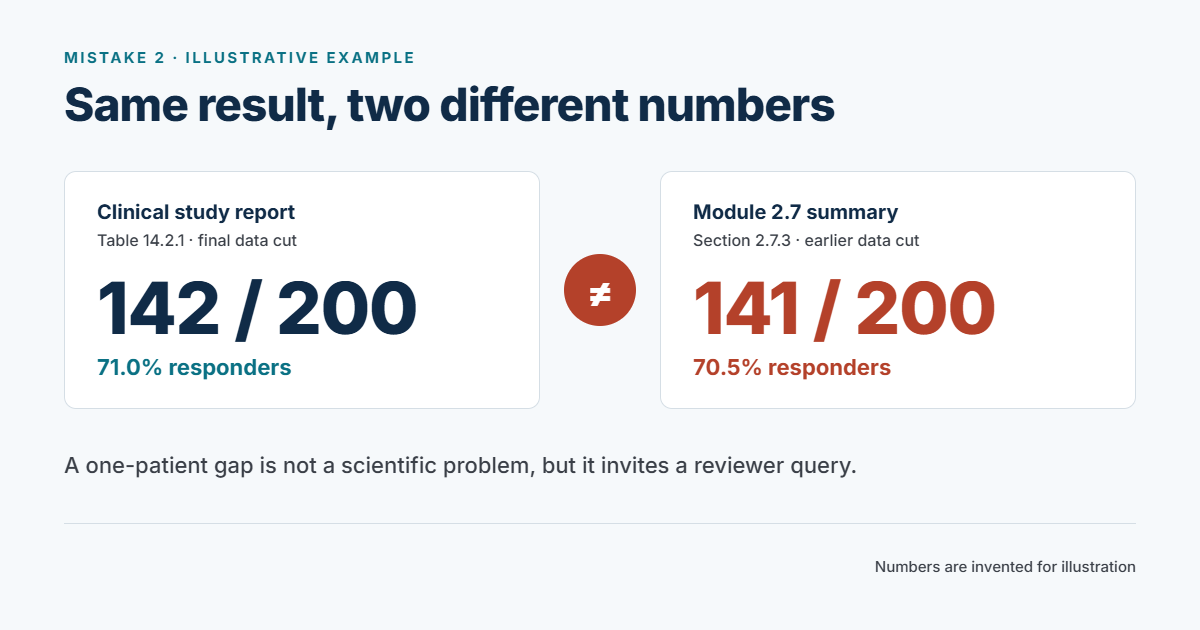
The same result appears differently in the clinical study report (CSR), the Module 2 summaries, the label and the investigator’s brochure. Reviewers notice, and they begin to question the reliability of the whole package. Illustrative example: The primary endpoint result is rounded one way in the CSR and another way in the Module 2.7 summary, or a population count differs by a few patients because one document used an earlier data cut. Neither is a scientific problem, but both invite a query. Instead, keep a single source of truth for key numbers, and run a cross-document consistency check before every major milestone.
3. Summaries that repeat data instead of interpreting it
Module 2.5 (Clinical Overview) and Module 2.7 (Clinical Summary) have different jobs. The overview should argue the case. A document that restates results table by table leaves the reviewer to draw the conclusions.
Illustrative example: An overview lists efficacy results and safety findings in separate sections but never says why the benefit outweighs the risk in the intended population. Instead, state the benefit-risk reasoning explicitly. Explain what the data mean, why the dose and population are justified, and how the risks will be managed.
4. Treating all regions the same
A dossier built for one authority is often reused for another with only light edits. FDA, EMA and MHRA have different expectations on format, content, labeling and local requirements. Instead, map regional requirements at the start, and plan region-specific content from the outset rather than adapting at the end.
5. Weak traceability
A reviewer reads a claim in a summary and cannot find where it comes from. Time is lost searching, and confidence drops. Instead: Cross-reference every key claim to a table, figure or section of the source document, and recheck the links after each revision.
6. Not carrying agency feedback into the documents
Advice from scientific advice meetings or pre-submission interactions is discussed internally but never reflected in the final documents. This looks like the sponsor ignored the agency’s input. Instead: Keep a log of agency agreements and recommendations, and check each one against the final documents.
7. Uncontrolled late changes
A last-minute data update or edit is made in one document and not carried into the others. Version mismatches follow. Instead, set clear cut-off dates and a change-control process, with one person approving any change that affects more than one document.
8. Misalignment between clinical and quality sections
Statements about the product in clinical documents, such as formulation, strength or presentation, don’t match the quality documentation. These mismatches are easy to miss when different teams write different sections.
Instead, identify the statements shared between clinical and quality sections, and have both teams review them together.
9. Gaps in data integrity documentation
If data cannot be shown to be attributable, complete and accurate, questions arise about everything built on them. Documents that describe data handling, corrections or deviations vaguely add to the concern.
Instead: Confirm that source data, audit trails and corrections are documented, and that the written description of them is accurate and consistent.
10. Too little quality control and unrealistic timelines
Review cycles are compressed to hit a date, and errors that a proper check would catch pass through to submission. Instead: Build in independent QC, plan for realistic review rounds, and prepare in advance for the questions an authority is likely to ask.
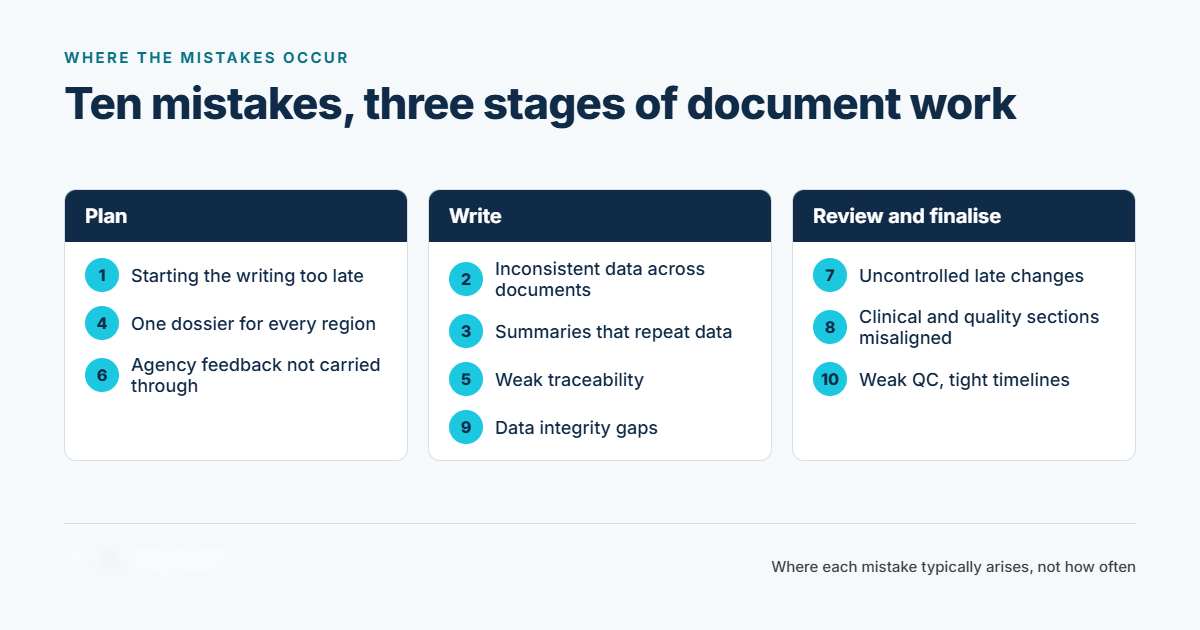
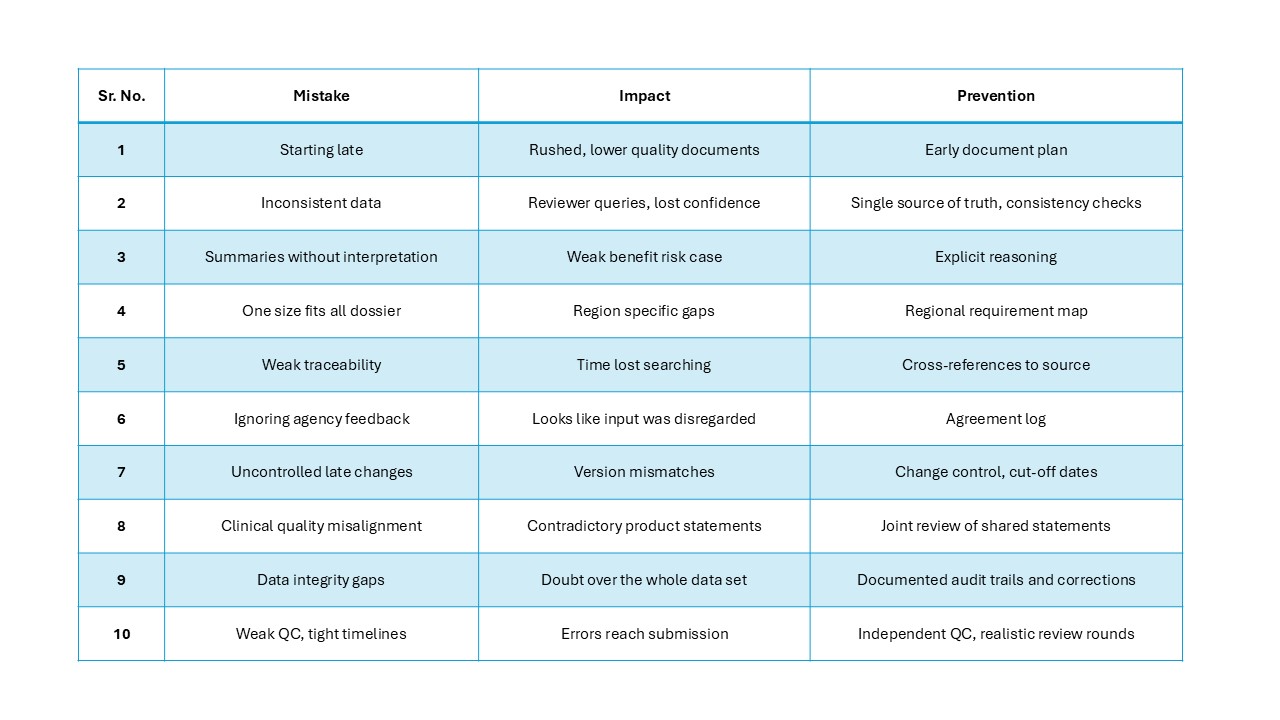
The ten mistakes at a glance
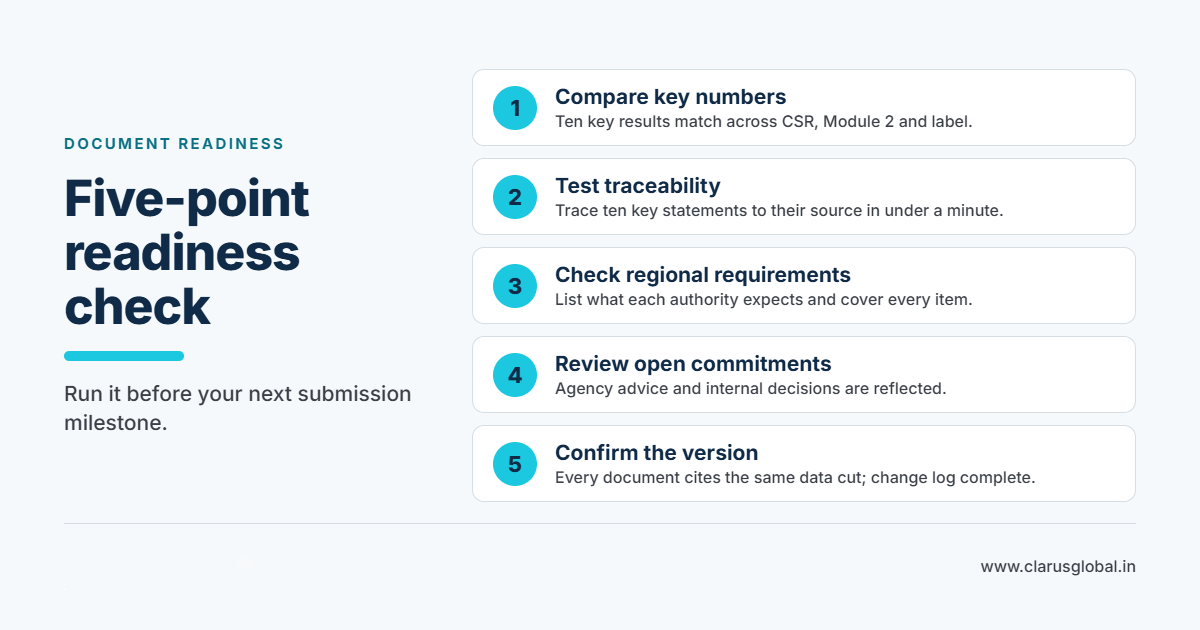
A five-point readiness check
Run this before your next submission milestone:
1. Compare key numbers. Pick the ten most important results and verify they match across the CSR, Module 2 and the label.
2. Test traceability. Choose ten significant statements in the summaries and confirm each one can be traced to its source in under a minute.
3. Check regional requirements. List what each target authority expects and confirm every item is covered.
4. Review open commitments. Check that agency advice and internal decisions are reflected in the documents.
5. Confirm the version. Make sure every document references the same data cut, and that the change log is complete.
Small checks like these are inexpensive compared with the cost of a review delay
Want a second pair of eyes on your documents?
Clarus Research offers a free 20-minute document gap discussion. Tell us about the document set you are preparing, such as a CSR, Module 2 summaries or a dossier section. We will point out where inconsistencies, traceability gaps or regional misalignments are most likely to draw reviewer questions, and what to fix first. There is no obligation. We treat everything you share as confidential, and an NDA is available on request.
To book, write to contact@clarusglobal.in or visit www.clarusglobal.in