
An inspection is rarely lost on the day. It is lost in the months before, when documents drift out of step with each other, procedures stop matching what people actually do, and nobody checks.
Inspectors from FDA, EU member states and MHRA know that no organization is perfect. Deviations happen. What they look for is control: do you know what your processes say, do you follow them, and when something goes wrong, do you find it, record it and fix it for good? The MHRA says as much in its advice to teams hosting an inspection: being open about known problems, with a CAPA plan already in place, reflects a healthier quality system than hoping they go unnoticed.
This guide walks through nine steps to get ready. It is written for sponsors, CROs and sites preparing for a clinical research inspection. FDA’s Bioresearch Monitoring program, for example, inspects clinical investigators, sponsors, CROs and institutional review boards, and most of the steps here apply to other inspections too. If you only have time to start with two steps, start with the first two. They show you what needs fixing.
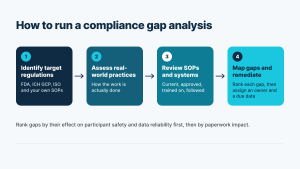
1. Conduct a gap analysis
A gap analysis compares three things: what the regulations and guidelines require, what your SOPs say, and what your teams actually do. A gap exists wherever those three disagree.
• Pick your benchmark: List the requirements that apply to your work, such as ICH GCP (E6), the FDA regulations for clinical investigations, EU and MHRA clinical trial requirements, your protocols and your own SOPs. For manufacturing sites, add the relevant GMP and ISO standards.
• Look at real practice: Sit with the people doing the work. Ask how they file a document, handle a deviation or approve a change. Inspectors will ask your staff, not just read your SOPs: the MHRA expects interviewees from day-to-day roles, not only senior managers.
• Review SOPs and systems against that practice: Check that procedures are current, approved, trained on and followed, and that document control works as written.
• Map and rank the gaps: Rate each gap first by its effect on participant safety and data reliability, then by paperwork impact. Give every gap an owner and a due date.
2. Run a self-audit
Internal reviews should be scheduled, not something you start the month before an inspection. Treat your own findings the way you would treat an inspector’s.
• Use reviewers who did not write the documents. Authors read what they meant to write, not what is on the page.
• Sample and follow the thread. Pick a study or a process and trace it from protocol to study report to trial master file.
• Record every finding with a risk rating, an owner and a due date, and track each one to closure.
• Run at least one mock inspection. Have someone play the inspector, ask for documents with a time limit and ask your staff real questions.
3. Prepare the documents
Start with the documents inspectors ask for most: the protocol and its amendments, Investigator’s Brochures (IBs), informed consent forms, Clinical Study Reports (CSRs), the trial master file (TMF), plans such as monitoring and data management, training records, delegation logs, and regulatory and ethics approvals. For each one, check that it is accurate, complete, consistent with the others, approved, and signed and dated where required.
One rule matters more than the rest: never create, backdate or quietly alter a record to close a gap. ICH E6(R3) expects source records to be attributable, legible, contemporaneous, original, accurate and complete, and says changes should not obscure the original entry. If something is missing, file it now with today’s date and a short note explaining why it is late. A late record with an honest explanation is far easier to defend than one that looks backdated.
4. Review the documents the way an inspector would
Read each document with the questions an inspector is likely to ask:
• Where does this number come from?
• Who approved this, and when?
• Which version was in use on this date?
• Why is this field blank?
Then look for the usual problems: missing information, numbers that differ between documents, superseded versions still in circulation, and references that point to a section or appendix that no longer exists. A quick test: pick ten statements from a study report and trace each one to its source. If any takes more than a minute or two, the cross-references need work.
5. Organize documents so they can be found fast
During an inspection, you will be asked for documents and the clock will be running. A document that exists but cannot be found quickly looks the same as a document that is missing.
• Treat the TMF as the basis of the inspection. The MHRA states that the complete TMF is the basis for inspection, and it treats failure to provide a TMF that is complete and readily accessible as a critical finding.
• File as you go. ICH E6(R3) asks sponsors and investigators for record management that keeps record integrity and traceability, with essential records available to regulators on request. A TMF filled in at the last minute is easy to spot.
• Use clear names and version control. Anyone should be able to tell which version is current and which are superseded.
• Keep an index. A simple index of where each document type lives saves time under pressure.
• Limit and log access. Authorized people only, with a record of who changed what.
• Test retrieval. Ask a colleague to find ten random documents against a timer. Fix the filing wherever it takes too long.
6. Build a culture of compliance
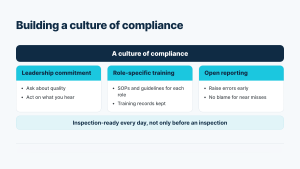
Procedures and checklists only work when people follow them without being watched. Three things make the biggest difference:
• Leadership commitment. Managers set the tone. When leaders ask about quality and act on what they hear, others do the same.
• Training that is specific. ICH E6(R3) says individuals should be qualified by education, training and experience for their tasks. Train people on the SOPs, guidelines and documentation standards for their own role, and keep the training records.
• Open reporting. People should be able to raise an error or a near miss without fear of blame. Problems you hear about early are far cheaper than problems an inspector finds. The MHRA says its inspectors aim to be open and honest and expect the same in return.
7. Prepare an inspection-day plan
Decide before the inspector arrives who does what. The MHRA’s advice on hosting a GCP inspection is a good model, whichever authority is coming:
• A senior host. Someone who knows the organization well enough to know where to find answers, and who can be reached throughout the day.
• A scribe. Inspectors expect one, and a QA representative may attend. Keep the group a reasonable size.
• Interviewees from day-to-day roles. The people who do the work should be ready to talk through the end-to-end process and show the evidence in the documents.
• A tested request process. Agree how document requests will work with the lead inspector, and set up and test any electronic repository in advance. Where a document is already in the TMF, show it there rather than sending a duplicate. Give complete documents, not redacted or shortened ones.
• A request log and a daily debrief. Note each request, who handled it, what was provided and when. At the end of each day, review what is still outstanding and fix it before the next morning.
Brief your staff on three rules: answer the question that was asked, give accurate information, and if you do not know, say so and find out. Never guess. If a requested item is unavailable or will take time to find, tell the inspector early so the request can be narrowed. Raise any concern about a finding when it first comes up, not at the closing meeting, when only written responses are possible.
Inspections are not always fully on site. FDA’s program includes remote regulatory assessments, and the MHRA notes that staff may dial in for interviews, so test screen sharing and secure document transfer beforehand.
8. Handle the period after the inspection
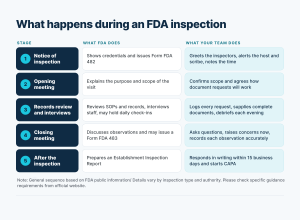
• Review the findings carefully. At the end of an inspection FDA may issue a Form 483 listing its observations. The MHRA grades findings as critical, major or other, and the EMA describes critical findings as conditions, practices or processes that adversely affect the rights, safety or well-being of subjects, or the quality and integrity of data. Read each one closely and make sure you understand what evidence led to it.
• Respond on time. Authorities set response deadlines. For drug manufacturing inspections, FDA’s March 2026 draft guidance recommends one organized written response within 15 business days. Ask your inspector what applies to your inspection. In the UK, the MHRA says responses must take the form of a CAPA plan.
• Build an action plan. Give each finding an owner, a timeline and a specific action. FDA’s draft guidance asks for actions that are realistic, measurable and achievable, and warns that promised or partly completed actions do not stop the agency acting at any time. So commit only to what you can deliver.
• Fix the cause, not just the finding. That is where CAPA comes in.
9. Use CAPA to fix problems for good
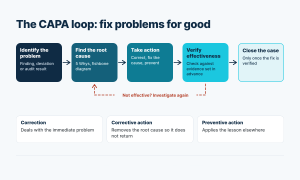
Corrective and preventive action (CAPA) is a loop: find the problem, find why it happened, fix it, then check that the fix worked. ICH E6(R3) builds the same idea into GCP, asking for strategies to avoid, detect, address and prevent recurrence of serious noncompliance. Each step has its own job.
• Correction deals with the immediate problem.
• Corrective action removes the root cause so the problem does not return.
• Preventive action applies the same lesson elsewhere, so similar problems do not appear in other places.
For the root cause, use a structured method such as the 5 Whys or a fishbone diagram. Be careful with “staff were not trained” as an answer. It is often a symptom. Ask why the training did not prevent the problem.
Example: Signed monitoring reports are being filed late. The correction is to file the missing reports now. The investigation finds that no one is reminded when a report is due. The corrective action is to add a tracked due date and a named owner. The preventive action is to apply the same tracking to other report types.
Finally, check effectiveness before closing the case. FDA’s draft guidance expects CAPAs that are measurable and verified for effectiveness. Decide in advance what evidence will show the fix works, for example no late filings in a sample of records over the next three months, and then review that evidence.
Before you call yourself ready
Inspection readiness is not a project with an end date. It is a habit of finding problems, recording them honestly and fixing their causes. Use this short check at each quality review:
☐ Gap analysis done, with every gap ranked, owned and dated
☐ Self-audit or mock inspection completed in the last 6 to 12 months
☐ Key documents are consistent, approved and signed where required
☐ Ten random documents can be retrieved in a few minutes
☐ Inspection-day roles are named and staff have been briefed
☐ Open CAPAs have an owner, a due date and a way to check effectiveness
Want a second pair of eyes on your documents?
Clarus Research offers a free 20-minute document gap discussion. Tell us about the document set you are preparing, such as a CSR, Module 2 summaries or a dossier section. We will point out where inconsistencies, traceability gaps or missing approvals are most likely to draw an inspector’s questions, and what to fix first.
There is no obligation. We treat everything you share as confidential, and an NDA is available on request.
To book, write to contact@clarusglobal.in or visit www.clarusglobal.in.
Sources and further reading
Links last checked on 30 October 2026. Regulations and guidance change, so check the current version before you rely on any of them.
- ICH, E6(R3) Guideline for Good Clinical Practice (final consolidated version)
- MHRA Inspectorate blog, GCP inspections: expectations and the dos and don’ts for hosting
- MHRA, Good clinical practice for clinical trials
- FDA, Bioresearch Monitoring program information
- EMA, Points to consider on GCP inspection findings and benefit-risk balance
- Venable LLP, FDA draft guidance provides roadmap for responding to Form 483 observations, a summary of FDA’s March 2026 draft guidance Responding to FDA Form 483 Observations at the Conclusion of a Drug CGMP Inspection